secondhand
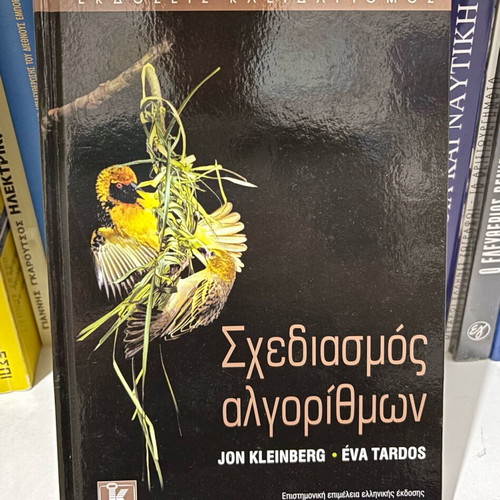
Algorithm Design book new, Greek language
This title was generated by AI and may not be fully accurate.
This title was generated by AI and may not be fully accurate.
 Algorithm Design book new, Greek language
 Algorithm Design book new, Greek language
 Algorithm Design book new, Greek language

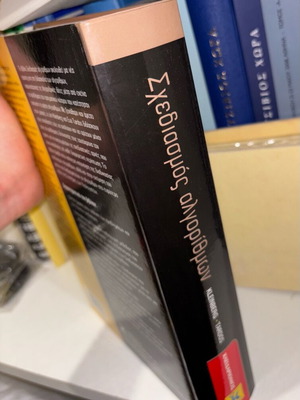
New • Language: Greek
#programming • #academicbooks • #computerscience • #kleidarismos • #algorithmdesign
ALGORITHM DESIGN
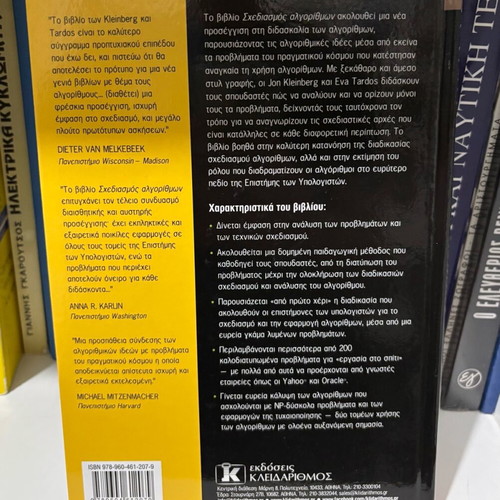
The book "Algorithm Design" follows a new approach to teaching algorithms, presenting algorithmic ideas through real-world problems that necessitated the use of algorithms. With a clear and direct writing style, Jon Kleinberg and Eva Tardos teach students how to analyze and define problems on their own, while simultaneously showing them how to recognize the design principles that are appropriate in each different case. The book aids in a better understanding of the algorithm design process, as well as in appreciating the role that algorithms play in the broader field of Computer Science. Among many other topics, the book covers the following: Basic elements of algorithm analysis (Computational solvability, Asymptotic growth rate, Implementation of the Stable Matching algorithm with lists and tables, etc.) Graphs (Basic definitions and applications, Graph connectivity and graph traversal, Directed acyclic graphs and topological sorting, etc.) Greedy algorithms (Interval scheduling: The greedy algorithm prevails, Scheduling to minimize delay: a swap argument, etc.) Divide and conquer (A first recursion: The Mergesort algorithm, Further recursive relations, Counting inversions, Finding the closest pair of points, etc.) Dynamic programming (Weighted Interval Scheduling: A recursive process, Principles of dynamic programming, Negative cycles in a graph, etc.) Network flow (The Maximum Flow problem and the Ford-Fulkerson algorithm, Maximum flows and minimum cuts in a network, Choosing good augmenting paths, etc.) NP and computational intractability (Polynomial-time reductions, Reductions via "micro-tools": The Satisfiability problem, Efficient certification and the definition of NP, NP-complete problems, Sequence alignment problems, etc.) PSPACE: A class of problems beyond NP (Some hard PSPACE problems, Solving quantified problems and games in polynomial space, etc.) Extending the limits of solvability (Finding small Vertex Covers, Solving NP-hard problems on trees, Coloring a set of circular arcs, etc.) Approximation algorithms (Greedy algorithms and optimality bounds: The Load Balancing problem, The Center Selection problem, etc.) Local search (The landscape of an optimization problem, The Metropolis algorithm, Simulated Annealing, Application of local search to Hopfield neural networks, etc.) Randomized algorithms (A first application: Solving competition, Finding the universal minimum cut, Random variables and their averages, etc.)
€ 30,00
New • Language: Greek
FREE Buyer protection
We guarantee that you will receive the item or your money back. Learn more



Buy more, pay less 🛍️
Select more items from the same seller. Negotiate a better price, save on postage.