secondhand
Aristophanes Lysistrata used book
This title was generated by AI and may not be fully accurate.
This title was generated by AI and may not be fully accurate.
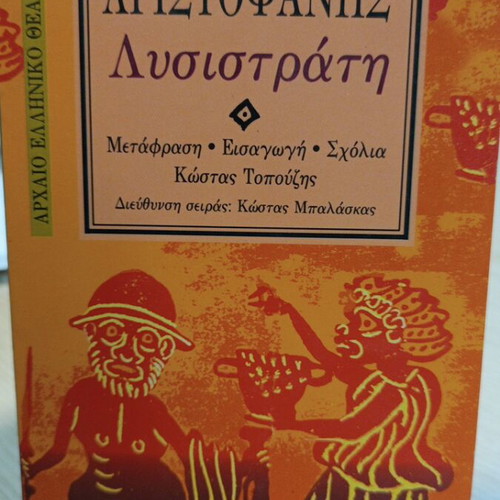 Aristophanes Lysistrata used book
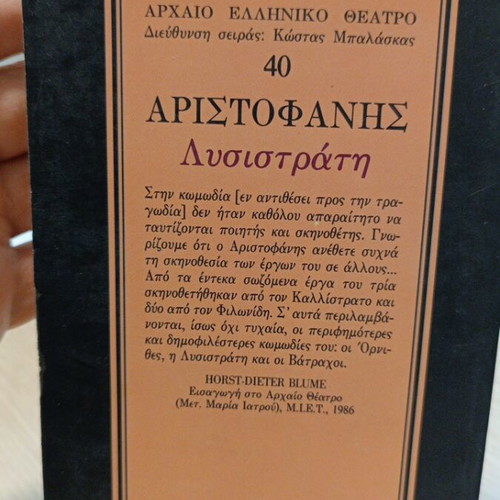 Aristophanes Lysistrata used book
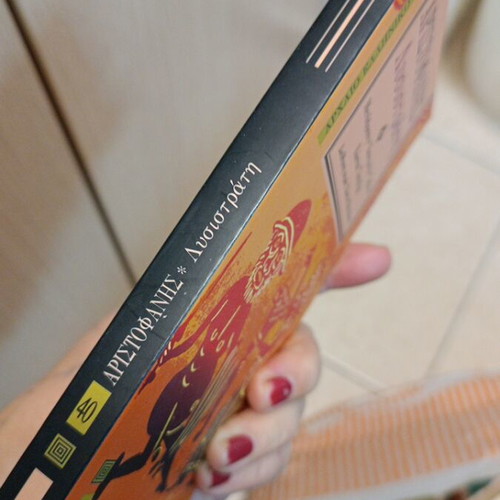 Aristophanes Lysistrata used book
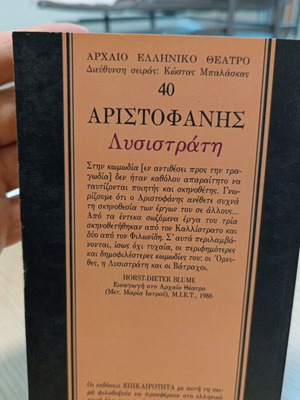
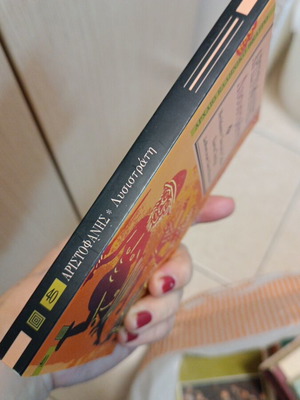
Used • Language: Greek
ARISTOPHANES: LYSISTRATA
Presentation
In the series of Aristophanean comedies, the prominent, if not the foremost, position is held by "Lysistrata," in which women again play the main role. We have already seen them in "The Ecclesiastics," trying to correct the "ills" of the state, which suffered from men's foolishness. I also encounter them here in a more serious effort, a sacred role, as is the role of the reconciler of warring peoples, whom the intoxication of war prevents from seeing the destruction to which each one, sooner or later, will lead his homeland. (This concerns the protagonists of the Peloponnesian War.) Of course, the means used by Lysistrata, the representative of women, to succeed in her purpose—worthy of an Aristophanean comedy—despite the laughter and mirth it provokes in the audience, particularly highlight the unquenchable desire of the common masses, especially defenseless women and children, civilians, to find a way to end the Peloponnesian War, which had begun twenty years earlier. From this perspective, the contribution of "Lysistrata" was significant in calming the warlike spirits. Besides its theoretical aspect, "Lysistrata" holds, especially for us moderns, an incalculable literary value. The ancient Attic dialect used by the poet, the literary devices, and the beautiful plot make this comedy very interesting even for today's viewer, who watches it with the same good disposition as the ancient did when witnessing the events. Because the spirit, mainly the psychology of the work, not the era, speaks directly to the human soul and always makes it relevant and alive. It is obvious that translating such a work is extremely difficult, primarily in faithfully conveying the spirit of that time and adapting it to our context, and secondly due to the abundance of vulgarisms, which are more numerous here than in any other work of Aristophanes. As for the latter, there is a general belief that Aristophanes is not Aristophanes without his obscenities. [...]
€ 4,00
Used • Language: Greek


FREE Buyer protection
We guarantee that you will receive the item or your money back. Learn more


ΒΙΚΥ για όσους αγαπούν τα βιβλία και τα ωραία πράγματα

 Vrilissia, 15235, Greece
Vacation mode is ON until 29/08
The seller can still receive messages. Send a message to express your interest.

Buy more, pay less 🛍️
Select more items from the same seller. Negotiate a better price, save on postage.