secondhand
Statics of Linear Structures Volume Two Matrix Statics new
This title was generated by AI and may not be fully accurate.
This title was generated by AI and may not be fully accurate.
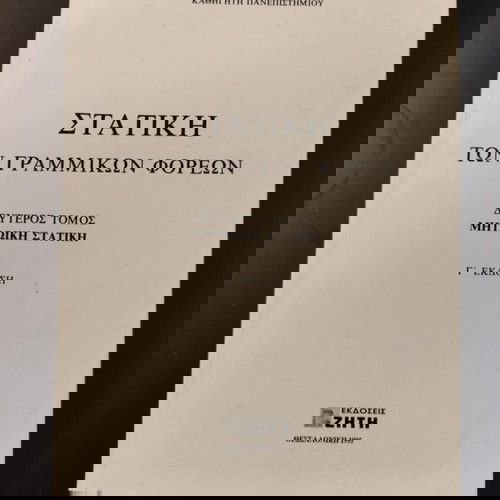 Statics of Linear Structures Volume Two Matrix Statics new
New • Language: Greek
#academictextbook • #engineeringbooks • #civilengineering • #zitipublications • #matrixstatics
STATIC OF LINEAR CARRIERS - NITSIOTAS G. - DEPARTMENT OF CIVIL ENGINEERING AUTH
After the exhaustion of the second edition, I deemed it necessary to undertake a radical revision of the content of my manuscript, so that it would be freed from outdated methods and would include the latest matrix methods. Static analysis with matrices (abstract static) began to be imposed in the practice of the European space as early as the early sixties, without, however, displacing classical static (supervisory static) to this day. Thus, in German-speaking polytechnics, but especially in those of Eastern countries, classical static continues to firmly hold its dominant position in teaching, while matrix static is attached to it as another methodology. In contrast, in English-speaking countries, matrix static has gained complete autonomy, resulting in a complete weakening of classical static. At the Polytechnic School of Thessaloniki, the basics of matrix static have been taught since 1965, initially based on rough notes. These formed the content of a special chapter of my book "Hyperstatic Structures." Later, in 1973, this chapter was published in a standalone issue titled "Static of Matrices." However, developments in teaching and practice necessitated the promotion of matrix static and its integration into the main teaching content. The question, of course, was whether it would be given priority. After a decade of reflection, I embraced the view that under current conditions, it was pedagogically more appropriate to subordinate matrix static to classical static. Because the latter, apart from being the daily tool of the statician for addressing current problems, is the only one that ensures the ability to understand the function of the structure and to generally predict its behavior. Moreover, the transition from classical to matrix static is achieved with minimal effort, but the reverse does not hold true. Based on the above thoughts, the content of the two volumes of the two previous editions was merged into one volume, titled "Classical Static." This was achieved, on the one hand, by omitting those chapters that are at least partially known from technical mechanics and, on the other hand, by limiting it to those from classical static that are currently theoretically and practically necessary. Thus, the second volume, much more concise, could be made available for the development of matrix static of linear structures. Essentially, the structure of the content of this edition's classical static does not differ from the two previous editions. The second volume, that is, the volume of matrix static, has been subdivided into two parts. The first of these is dedicated to somewhat general topics and specifically to a concise summary of the main aspects of matrix theory, the classical method of calculating spatial structures, and a development of the matrix theory of linear structural elements. The second part of the volume in question and the seventh of the manuscript refers to the matrix theory of linear structures. This includes structures with point connections of their elements, solution methods, work methods, and an introduction to the theory of structures with unilateral connections.
€ 13,00
New • Language: Greek

FREE Buyer protection
We guarantee that you will receive the item or your money back. Learn more


Buy more, pay less 🛍️
Select more items from the same seller. Negotiate a better price, save on postage.