secondhand
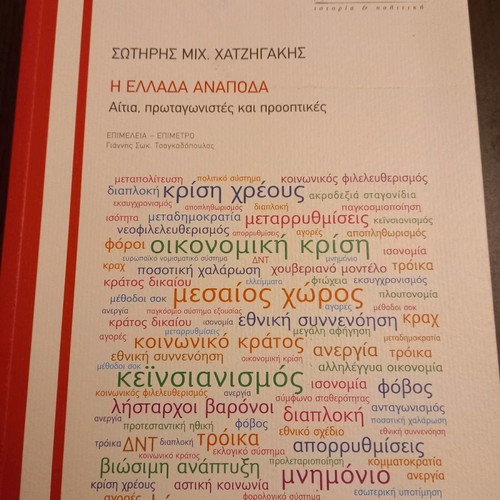
Greece Upside Down new, Sotiris Chatzigakis
This title was generated by AI and may not be fully accurate.
This title was generated by AI and may not be fully accurate.
 Greece Upside Down new, Sotiris Chatzigakis
 Greece Upside Down new, Sotiris Chatzigakis
View gallery
New • Language: Greek
#greekbooks • #politicalphilosophy • #modernhistory • #economiccrisis • #sotirischatzigakis
GREECE UPSIDE DOWN -Causes, Prospects and Prospects -Sotiris Chatzigakis
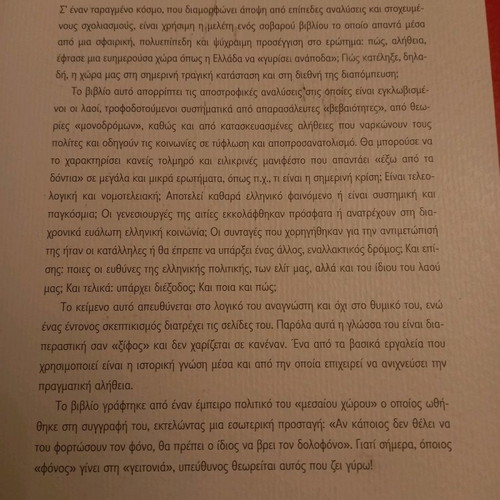
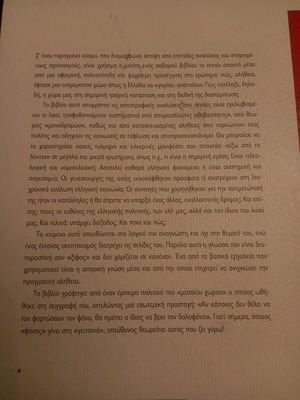
How did a prosperous country like Greece end up 'turned upside down'? How did it reach its current tragic state and international disgrace? This book rejects the disjointed analyses in which peoples are trapped, systematically fed by unshakeable 'certainties', by 'one-way' theories, as well as by fabricated truths that numb citizens and lead societies to blindness and disorientation. One could characterize it as a bold and sincere manifesto that answers 'straight from the shoulder' to big and small questions: What is the current crisis? Is it teleological and deterministic? Is it purely a Greek phenomenon or is it systemic and global? Did its root causes hatch recently or do they date back to the chronically vulnerable Greek society? Were the recipes provided for addressing it appropriate or should there have been another, alternative path? And also: what are the responsibilities of Greek politics, our elites, but also of our own people? And finally: is there a way out? And what is it and how? This text addresses the rationality of its reader and not their emotions, while a strong skepticism runs through its pages. Its language is penetrating like a 'sword' and spares no one. One of the main tools it uses is historical knowledge through which it attempts to trace the real truth.
INTRODUCTORY THOUGHTS A PHILOSOPHICAL APPROACH TO THE CRISIS
PART ONE: WHEN THE WORLD TURNED UPSIDE DOWN
1. The great turn of History
2. Towards a new architecture of the global order
3. The beginning of globalization
4. The 'new capitalism' of 'uncontrolled markets'
5. The triumph of inequalities
6. The current role of intellectuals, education, and culture
7. The collapse of the 'old society'
8. Europe's inability to face the crisis and tame the growth of banks
9. Rating agencies
10. IMF. A ruthless controller of peoples and 'gendarme' of international monetary policy
11. 'Metapolitics'-'Metademocracy'
12. The current decline of politics and the need for its upgrade
13. Neoliberalism and mild liberalism: the ideological approach to the crisis
14. The transcendence of the 'Right-Left' axis
15. The society of the 'center'
PART TWO: THE ROLE OF THE STATE IN MODERN TIMES
1. State and market
2. Return to the 'Middle Ages'
3. The imperfections of markets and the regulatory role of the state. The policy of privatizations
4. The 'state' in post-war Europe
5. Markets do not self-correct. They need 'regulatory counterweights'
6. The necessary interventions of the state in the agricultural sector
7. Investments with public and private spending
8. The symmetrical functioning of the principles of 'freedom' and 'equality' for a fair and social state
9. The state against the 'legal', the just and the moral of the 'markets'
10. Towards a new organization of our economic life
11. Taxation in the modern state
PART THREE: THE CHRONICALLY VULNERABLE GREEK SOCIETY
1. The early years of our national revival
2. From Liberation to the Asia Minor Catastrophe
3. Greece during the interwar period
4. From World War II to the dictatorship of the colonels
5. The Greek state of 'metapolitics'
6. The absence of a structured 'bourgeois' society
7. The time has come for the country to acquire a bourgeois consciousness
8. The 'clientelistic' relationships and the entanglements in Greek society
9. The demonization of the Greek state: Myths, truths, lies
PART FOUR: THE DEEP CRISIS OF EUROPE AND GREECE'S HEAVY 'WINTER'
1. Europe after the war. The 'glorious' European thirty years (1945-1975)
2. The 1960s: at the peak of the 'golden age'
3. The 'bloody' Europe of the 1970s. The beginning of the Greek 'metapolitics'
4. The European states in the 1980s and 1990s
5. At the twilight of the 20th century
6. Thoughts on 21st century Europe
7. Greece without a grand narrative
8. The Greek 'after'
9. The early years of 'metapolitics' (1974-1996)
10. The 'social face' of 'metapolitics'
11. The 'modernization' that never... reached our country
12. From 'partocracy' to the clutches of 'technocrats' and markets
13. From the 'center' to the memoranda
14. The barbarity of the memoranda leads to the 'false dilemma': euro or drachma?
15. The swelling of the crisis and the disgrace of the country
16. The truth about Greece's deficits and debt
17. Addressing high public debt. The deflationary policy is wrong
18. The hatching of the 'snake's egg'
19. The abolition of our Democracy
20. The ideological confusion of political parties during the memorandum period
21. A path into the 'blind' and without 'national consensus'
22. Absence of a plan
23. Coalition governments and a more proportional electoral system
CONCLUSION
APPENDICES
€ 7,00
New • Language: Greek
FREE Buyer protection
We guarantee that you will receive the item or your money back. Learn more



Buy more, pay less 🛍️
Select more items from the same seller. Negotiate a better price, save on postage.